

Forecasting for the Future: How Chesapeake Bay Anglers Use CBEFS to Outsmart “Bad Water”
November 14, 2025
Emily Davenport, MARACOOS Communications Manager
Chesapeake Bay anglers use CBEFS forecasts to track low-oxygen zones, harmful algal blooms, and other conditions for safer, more productive fishing.
For anglers on the Chesapeake Bay, few things are more frustrating than setting out for a day on the water only to find fishless, “bad water”—a local term for hypoxia, or water with dangerously low oxygen levels. For decades, fishermen have relied on personal experience and observation to predict where these zones might form and plan their day. Today, many are adding a new tool to their kit: the Chesapeake Bay Environmental Forecast System (CBEFS), developed by the Virginia Institute of Marine Science (VIMS), AnchorQEA, and other partners, including support from MARACOOS.
CBEFS provides real-time and short-term forecasts of conditions in the Bay, including temperature, salinity, dissolved oxygen, acidity, and harmful algal blooms. Using these “nowcasts” and five-day forecasts, fishermen can see how deep oxygen-rich water extends, where harmful blooms may appear, and how conditions are likely to change in the days ahead.
One charter captain said he checks the model before every trip. “Hypoxia levels steered me away from a few favorite speckled trout haunts and forced me to look for new spots,” he said. “I found several more; now I have nine different opportunities to take clients to when hypoxia is a problem, instead of six.”
How Chesapeake Bay Anglers Are Using CBEFS
Many of the anglers first heard about CBEFS through outreach from VIMS Extension specialists and tagging programs. “I learned about it through the Virginia Game Fish Tagging Program,” said another angler.

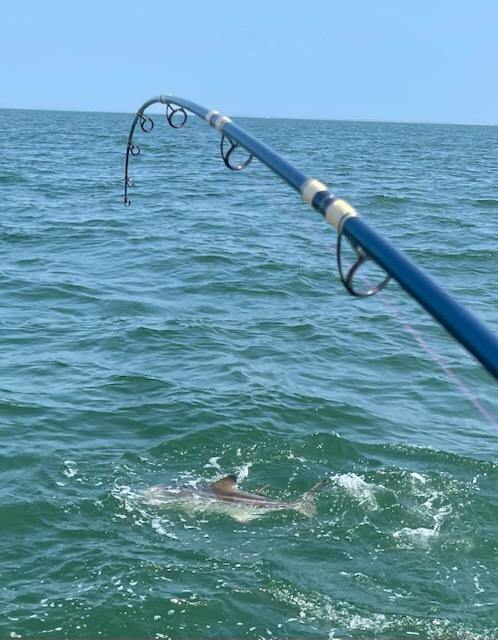
Photo credit: Alex Perez
For some, checking CBEFS has become routine. “I check it about once a week, especially when I’m hearing about red tide,” one angler explained. Another added, “After a big weather event or if it’s been several days since I last went out, I’ll pull up the forecasts to see how things have shifted.”

CBEFS forecasts of dissolved oxygen, dead zone size, depth to low oxygen, hypoxia over time, acidification and bay salinity. Explore these and more at vims.edu.
One shore-based angler said the model helped him avoid a respiratory irritation caused by a red tide event near Yorktown. “I started to feel scratchiness in my throat and eyes burning and realized what I was looking at. Now I check the model, and fish elsewhere when red tide conditions are forecast.”
Users also emphasize how much time and fuel the forecasts save. “Before, I might have had to run to a site to see if the water was bad, only to turn around and leave,” one said. Another added, “The forecast helped me decide between fishing the eastern or western side of the Bay. The western side had warmer water. That data saved me a trip and fuel.”
Tracking Changing Chesapeake Bay Conditions with CBEFS
Many in the focus group noted how the Bay’s conditions have shifted. “There are fewer striped bass in areas that used to hold them for years,” one angler reflected. “The [CBEFS] site helps me see which areas might still have good water quality and a higher potential for fish.”
Another participant observed that construction and shoreline changes have altered local hydrodynamics, making near-shore waters shallower and more vulnerable to red tide outbreaks. “Having these models helps confirm what we’re seeing firsthand,” he said.
Forecasting the Bay’s Future
CBEFS also serves as a planning and safety tool for aquaculture and shoreline users. The same data that helps fishermen locate healthy waters is used by power plants to anticipate sea nettle blooms that could clog their intake systems, or by managers monitoring harmful algal blooms and acidification trends that affect Bay ecology and shellfish aquaculture.
For the researchers developing the models, feedback like this underscores how science-based forecasting tools can directly support the Bay’s communities. By integrating observations, models, and user feedback, CBEFS continues to evolve as a bridge between research and on-the-water decision-making.

Photo credit: Alex Perez
CBEFS data are also available through the MARACOOS OceansMap, an interactive visualization platform that brings together ocean and coastal observations from across the Mid-Atlantic. Within OceansMap, users can view CBEFS forecasts for dissolved oxygen, temperature, salinity, harmful algal blooms, and more, overlaid with other regional forecasts such as currents, winds and wave information. This integration allows anglers, aquaculturists, and resource managers to combine near real-time CBEFS model output with other MARACOOS data streams to better understand and respond to changing conditions in the Bay.

CBEFS 3D Oxygen as viewed in OceansMap
–
As one of eleven certified U.S. IOOS regional associations, MARACOOS is dedicated to delivering high-quality ocean and coastal data to stakeholders, partners, and the public. OceansMap provides free and open access to critical data products that support decision-making in the Mid-Atlantic region, spanning from Cape Cod, MA, to Cape Hatteras, NC.



One response
[…] This story was originally posted on the MARACOOS website. […]